Origins of the Clasped Hands Belt Buckle Design: A Symbol of Enduring Love
In the hurry of life, they pass us by,
And the hands we have touched but a moment before
Drop lightly from ours, and so it ends,
And we acquiesce without knowing why;
But the spirit clasps hands for the Evermore.
With those who in deed and in truth are friends.
Anonymous, Victorian period (c. 1850–1890)
Rings and jewellery as love tokens have their origins in ancient Greece, often including direct representations of Aphrodite, the goddess of love, or motifs such as the Hercules knot, symbolising the groom's untying of the bride’s garments.
The earliest examples of clasped hands come from Rome. Known as the dextrarum iunctio, meaning "to join right hands," these rings signified a pledge of marriage recognised by the early Christian church. The Italian word fede, meaning "faith," is a later term still used to describe this type of ring. The fede motif resurfaced in England by the twelfth century, with the earliest datable English example coming from the Lark Hill hoard, deposited around 1173–1174. Like its Roman predecessors, this motif symbolised love and commitment to marriage.
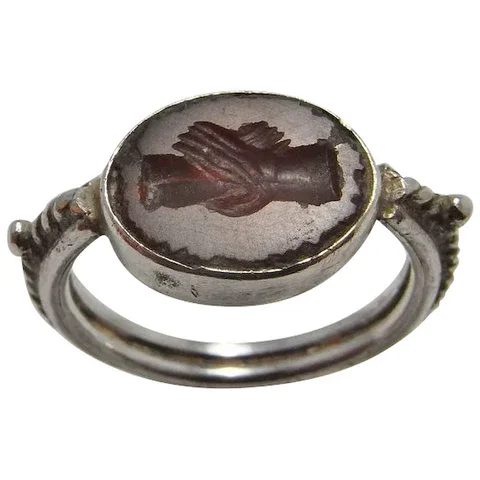
Roman fede rings depict a handshake, or a couple shaking hands.
In medieval Christian marriage rites, the joining of right hands formed part of the binding vow. This gesture, often called handfasting, symbolised consent, loyalty, and sacred union. The image of two hands clasped together became a visual shorthand for covenant and enduring commitment.
Medieval fede rings sometimes included secular poetic inscriptions, or posies, to express affection. While less common, some also featured sacred inscriptions of personal devotion. In medieval art and funerary monuments, clasped hands could signify unity beyond death. This motif appeared carved into tomb effigies of married couples, with their hands joined as a declaration of spiritual and marital continuity.
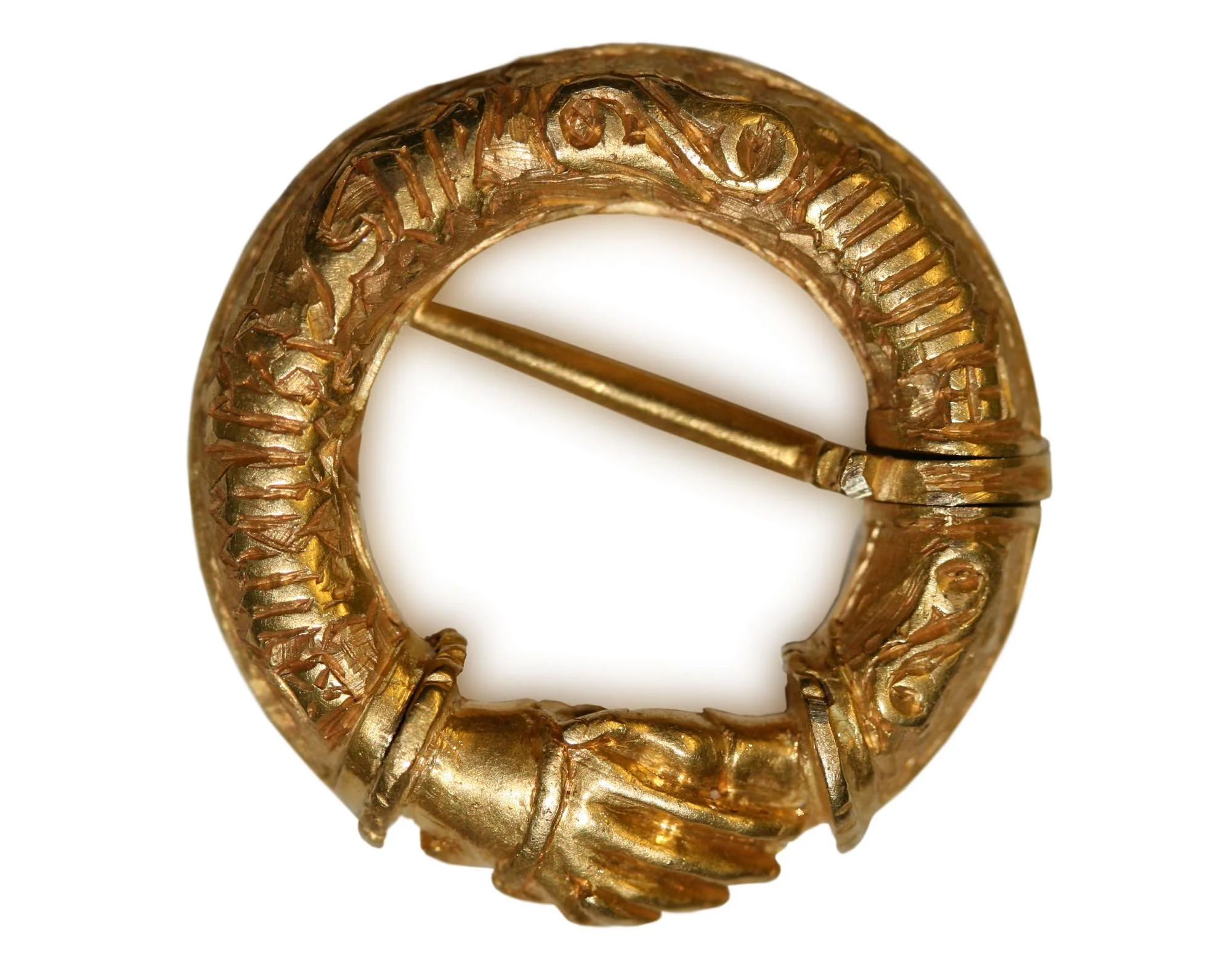
Gold Medieval fede brooch found in Winwick, Cheshire
Among the definitions of 'fede' in John Florio's 1611 Dictionarie of the Italian and English Tongues is "a ring made with hand in hand." The phrase "hand in hand" was also used in sixteenth and seventeenth-century England. For example, in 1577 Johan Broucker left her sister a "ringe of golde with an hande in hande."
While major museum pieces tend to represent the highest levels of craftsmanship, records from the Portable Antiquities Scheme reveal a wide range of styles and skills in medieval gold and silver finger rings. Some are crude, little more than flat forms with awkwardly incised lines suggesting fingers. Others are more carefully modelled and anatomically detailed.
By the Victorian period, the clasped hands motif continued this legacy of devotion. Victorian sentimental jewellery often used symbolic imagery rather than explicit wording. Clasped hands represented love, loyalty, and constancy. They were exchanged as tokens of affection and frequently incorporated into rings, brooches, and bracelets.
The Victorian fascination with symbolism allowed jewellery to communicate emotional depth without overt declaration. A simple pair of joined hands conveyed devotion, fidelity, and an unbreakable bond.
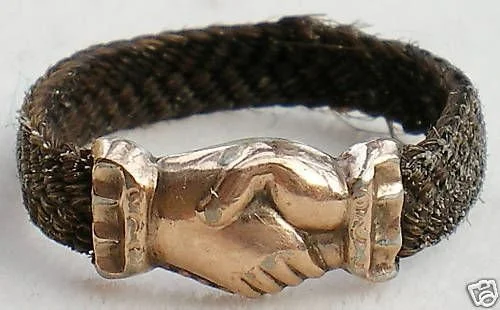
A Victorian fede ring, the plaited hair suggests this is a mourning ring, incorporating hair from the deceased.
In Georgian and Victorian periods, hand brooches and pendants were created not only in metal but also carved from precious materials such as lava, vulcanite, and Whitby jet. These brooches sometimes held flowers and hearts symbolising friendship and romance, daggers for protection, and wreaths for mourning.
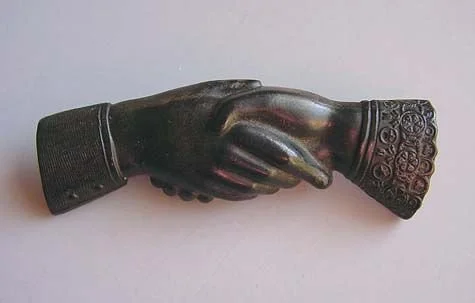
Clasped hands made from Whitby Jet
The clasping hand motif was also commonly found on gravestones. These carvings served as symbolic expressions of memory and enduring attachment. The hand on the left often represented the deceased, while the hand on the right symbolised the surviving partner. Together, they conveyed a love that endured beyond death.
The 1970s version of the Victorian clasping-hands belt is often associated with designer Georges Malian. He is recognised in vintage and fashion circles as a French sculptor and designer whose work featured prominently in accessories during the 1970s and 1980s. Items attributed to him include distinctive sculptural belt designs, such as a "dagger belt" signed "Malian" and belts adorned with clasped hands or surreal hardware. These pieces frequently appear in vintage fashion listings and auctions, and collectors highly seek them out for their unique forms and craftsmanship.
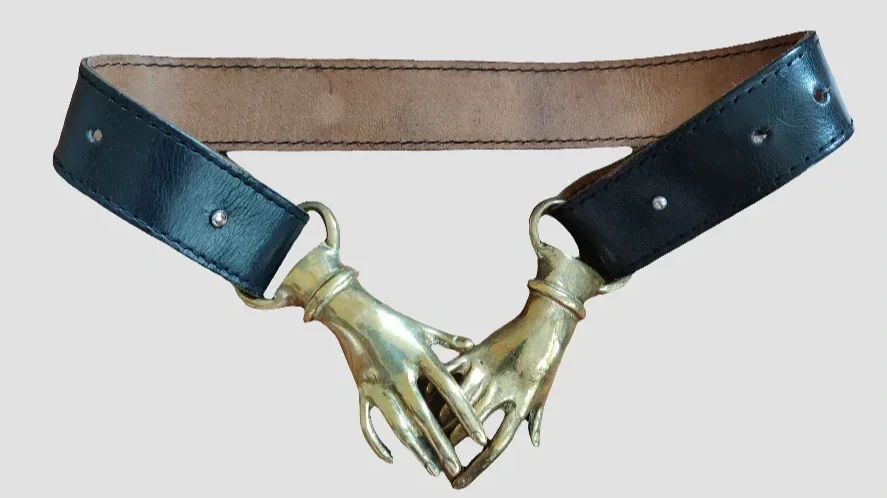
The Georges Malian belt buckle is identified by the makers mark
The available commercial references do not provide sufficient biographical information about the artist in major databases. This indicates that he likely focused on applied design or the production of artisanal accessories.
When people refer to the chunky 1970s Victorian revival clasping hands buckle, attributions can be unclear. Many vintage sellers attribute it to Georges Mailian, and some listings explicitly label these as “Georges Mailian” belts. However, other reputable listings describe the same style as having an “unknown” origin and refer to it as “in the style of Victorian revival, without naming a specific maker.
There is at least one clearly marked variant: a 1970s clasped-hands belt on 1stDibs marked “Park Lane U.S.A.,” indicating that Park Lane is the maker (or at least the brand associated with that specific buckle).
My own piece is certainly a recast of a Victorian original, but very little information about it is available, and many details have been lost to time. It is my fascination with the motif, the rarity of the design and the mystery surrounding their manufacture which led me to create my own pieces.
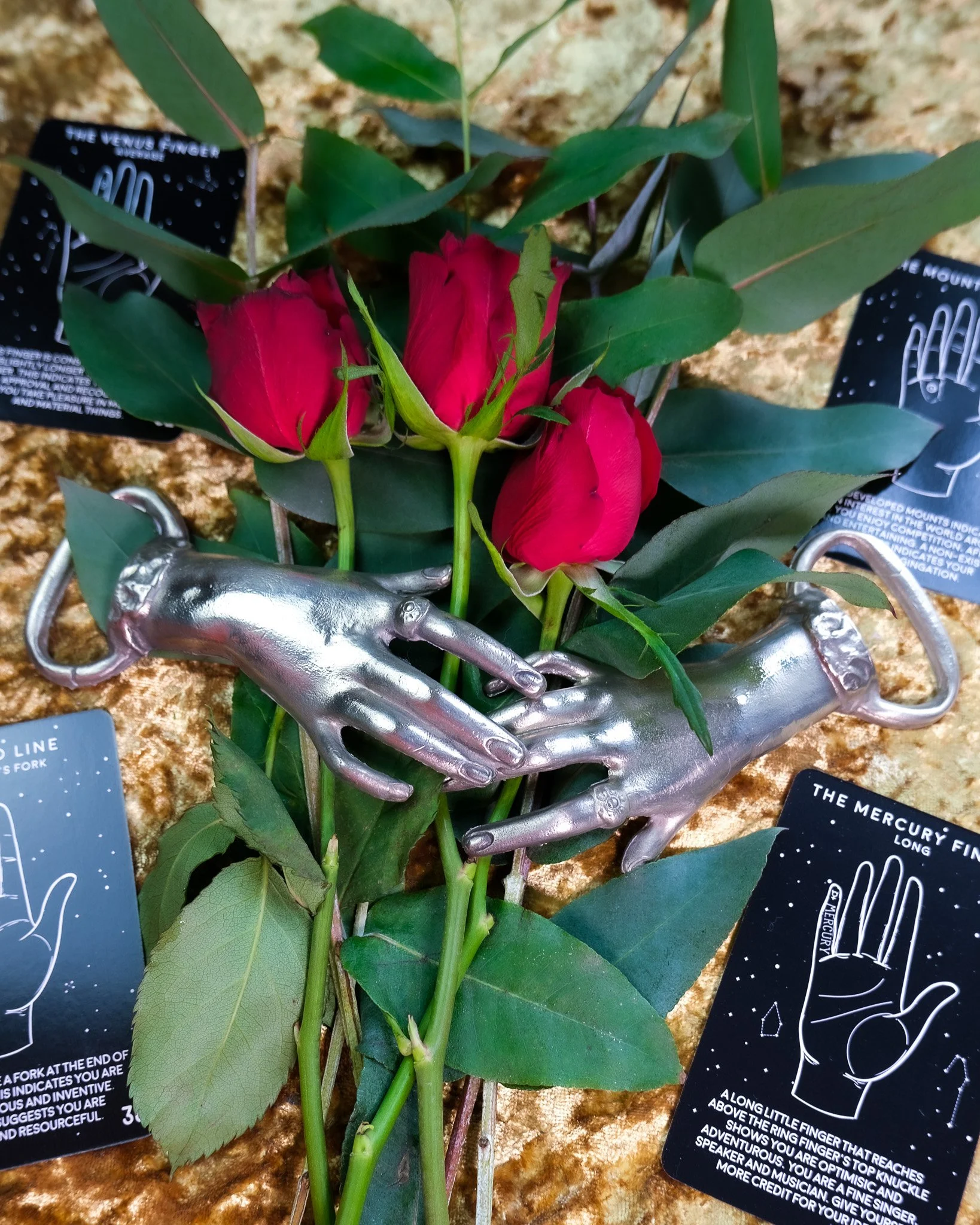
My own recreation of this timeless clasped hands belt buckle
Carefully crafted in small batches to ensure these pieces retain their charm. My clasped hands belt buckle is a direct replica of Victorian style, made from solid metal, either bronze or nickel silver.